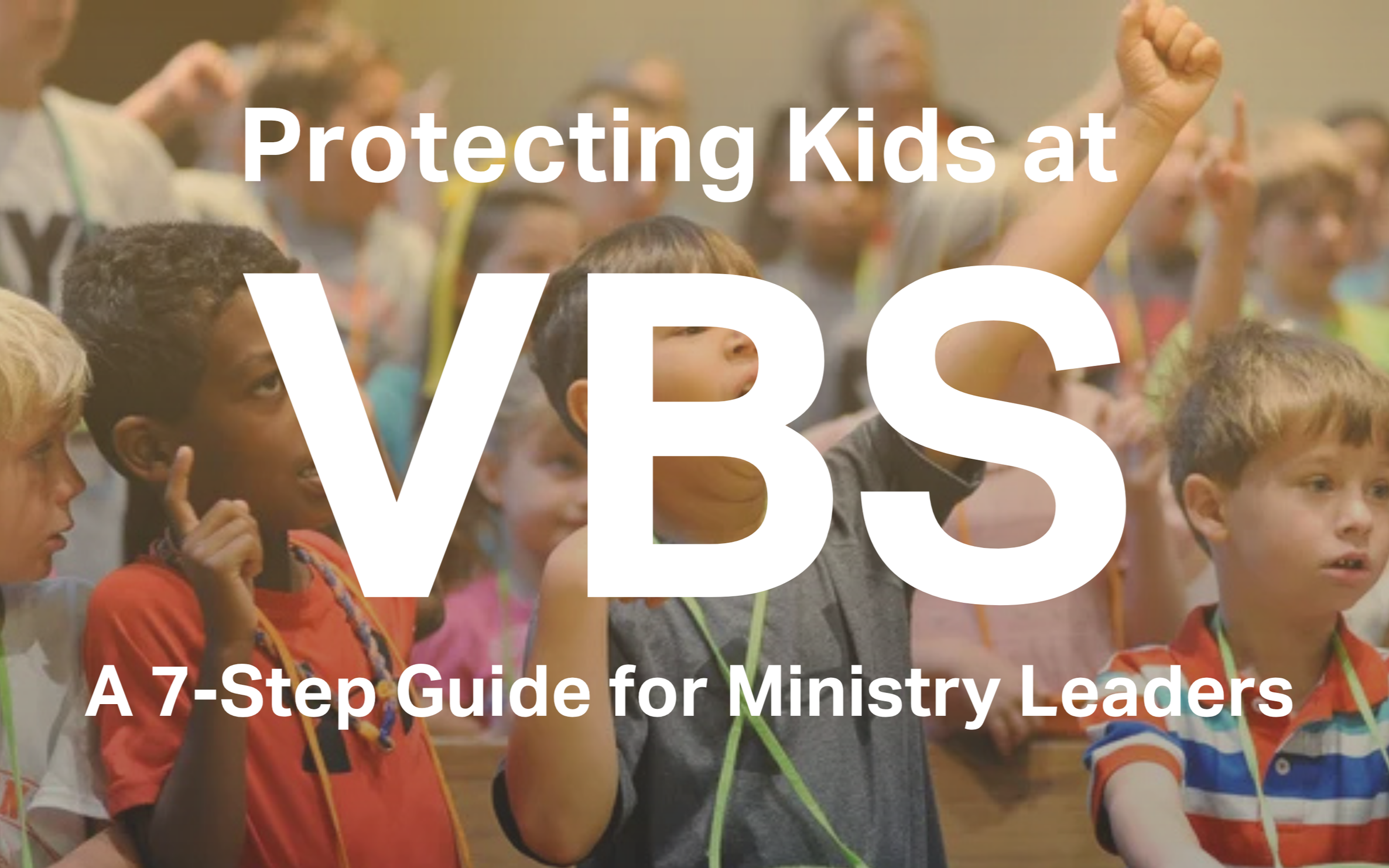
Protecting Kids at VBS
Vacation Bible School is often the most high-energy, chaotic, and beautiful week in the life of a children's ministry. But in the thick of planning decorations, games, and snacks, ensuring the safety and protection of the children in your care must be the baseline of your preparation. Offenders look for environments where privacy is easily accessed and chaos masks boundary violations.
Here are the top 7 things you need to prepare right now to make your VBS a sanctuary of safety and healing.
1. Deploy a VBS Safeguarding Team
Effective abuse prevention and response is the responsibility of the whole faith community. At VBS, every adult has a part in creating a safe environment for children; however, we recommend a dedicated Safeguarding Team to oversee safeguarding compliance.
Scenario: Imagine a volunteer notices a VBS crew leader giving a particular child extra snacks and small gifts. If that volunteer just mentions it in passing to a busy VBS director, it might be forgotten or brushed off. But with a centralized Safeguarding Team, this observation is documented. Later in the week, when another volunteer reports that the same leader was trying to be alone with that child, the team can immediately connect the dots, recognizing a potential grooming pattern.
Shared Oversight: Having a team ensures that the weighty responsibility of documenting safety concerns or policy violations is shared, rather than placed on one supervisor.
Pattern Recognition: Centralizing all safety concerns in one location is critical because grooming behaviors are difficult to recognize in isolation but become clearer when tracked as a pattern.
Diversity and Skill: If possible, include a mix of staff and lay persons, ensuring at least 50% are women. Tap into church members with professional experience in social work, law enforcement, or trauma therapy.
Already Actively Engaged: Ideally, it is best to have a Safeguarding Team in place permanently before VBS. For a practical guide on setting up a Safeguarding Team at your church visit our online Safeguarding Toolkit.
2. Clarify Standards for Healthy Boundaries
Abusers seek to push past healthy boundaries with touch, isolation, and other areas. Eliminating opportunities for private, unobserved access to children is one of the most effective deterrents you can implement for VBS week.
What if... a child has a bathroom emergency during a chaotic craft rotation, and a well-meaning teenage volunteer offers to take them alone? If you do not have clear, pre-communicated boundaries, the volunteer might end up alone behind closed doors with the child. Abusers actively look for this exact type of privacy, and eliminating it makes it much harder for an offender to succeed.
Two-Deep Leadership: Children must always be in the care of at least two screened volunteers. Even if a child needs to be removed from a group briefly, they must remain in the clear line of sight of another adult. Avoid pairing spouses or best friends as a team, as close relationships can inadvertently lead to covering up policy violations.
Windows and Open Doors: Keep classroom doors open or ensure they have clear windows so that anyone passing by can see what is happening inside.
Strong Bathroom Policies: Establish a zero-tolerance policy for one-on-one bathroom situations. For VBS, it is highly recommended that only parents provide bathroom assistance; if volunteers must assist, no single adult should ever be alone with a child in a closed restroom space.
Observable Touch: All physical affection (such as high-fives or side-hugs) must be welcomed by the child and fully observable by others. Ban intimate or inappropriate touch like lap-sitting, tickling, piggyback rides, or massages.
Strict Technology and Device Boundaries: Volunteers must stay off their phones to ensure active supervision. Enforce a "phone-free" policy for children to prevent cyberbullying and inappropriate messaging. Strictly ban all cell phones and cameras in bathrooms or changing areas to protect privacy.
Zero-Tolerance Content: Enforce a strict rule prohibiting any sexual language, inappropriate jokes, or suggestive media content among volunteers and students.
3. Implement Robust Volunteer Screening & Interviewing
Do not rely solely on a quick background check. While background checks are necessary, they are only one part of effective safeguarding. Many sexual offenders have never been charged or convicted of a crime, meaning a background check is not a comprehensive safety measure and will not provide all of the information necessary to clear a volunteer’s or staff member’s background.
Conduct Volunteer Interviews: Ensure all VBS volunteers understand and are willing to uphold the policy.
Use Scenario-Based Questions: Offer volunteers a hypothetical safety violation and ask how they would handle it. Be sure to empower volunteers to speak up. Make sure that it is clear regarding how they can report and to whom they can speak about concerning behavior.
Signal Seriousness: A rigorous screening process sends a powerful signal that your church is highly vigilant, which naturally deflects potential offenders who seek out easy, low-scrutiny environments.
During a volunteer interview, you present this hypothetical: "What would you do if you saw a popular, beloved church elder tickling a child in a corner during game time, which violates our physical touch policy?" If the applicant hesitates, makes excuses for the elder, or says they wouldn't want to cause trouble, that is a red flag. If they hesitate in a hypothetical situation, they will likely hesitate during the fast pace of VBS week.
4. Host Practical Safety Talks
Do not let fear prevent you from talking to kids about safety. Empowering children is a fundamental layer of defense, and bad actors prefer that minors remain uneducated and un-empowered.
Keep it Positive: They should be given clear examples about appropriate vs. inappropriate touch, empowerment and clarity to speak up. For elementary-aged kids, use age-appropriate books to discuss body boundaries.
Distinguish Secrets from Surprises: Explicitly teach children the difference between a fun surprise and an unsafe secret. Instruct them that they can always talk to a trusted adult if someone breaks a safety rule, and help them identify who those adults are.
Socialize Peer Expectations: Remind older youth that safety rules apply to them too. Since a significant amount of concerning behavior is committed by minors against other minors, teaching youth to respect peer boundaries is essential. Minors can also watch out for each other and encourage one another to speak up.
5. Build a Trauma-Informed VBS
A trauma-informed ministry realizes the widespread impact of trauma and actively seeks to resist re-traumatization. Statistically, one in four women and one in six men will be sexually abused before the age of eighteen, meaning a significant portion of your congregation—and the children walking through your doors—have already experienced profound trauma or abuse.
What if... a child suddenly becomes aggressive or completely shuts down and hides under a table during the loud, high-energy worship time? A trauma-informed volunteer recognizes that a child with trauma history may not be able to process the sensory overload and is responding out of survival-based coping strategies. Instead of punishing the child, the volunteer gently guides them to a pre-established quiet, safe space.
Shift Your Perspective: When a child misbehaves, screams, or completely shuts down during a VBS activity, train your volunteers to shift their perspective from "What is wrong with this kid?" to "What has happened to this kid?" Or "What does this child need?" (These examples are common to all children and don't necessarily mean there is a trauma history.)
Universal Precautions: Operate under a "universal precautions" framework. Assume that children carrying unseen psychological wounds are present in every group, and design your activities, lighting, sound levels, and transitions to be predictable, welcoming, and safe.
Provide Self-Care and De-escalation Spaces: Create a quiet, calming space where overwhelmed children (and staff) can step away from the loud music and chaos of VBS to practice self-care and safely de-escalate.
Read Toward A More Trauma-Informed Church to learn more about what it means to set up trauma-informed churches.
6. Protect Children with Disabilities
Children with disabilities are at least three times more likely to be abused or neglected than their peers without disabilities. They are also significantly more vulnerable to experiencing severe harm or sexual abuse because they may rely heavily on adults for daily care, face social isolation, or experience communication barriers.
Scenario: Consider a nonverbal child with a disability who seems unusually withdrawn, shrinks away from adults, and avoids a specific volunteer. If leaders assume this is just a symptom of the child's disability, they might miss a critical warning sign of physical abuse. Because children with disabilities are highly vulnerable, it is vital to provide them with alternative communication tools so they can convey distress accurately.
Tailor to Strengths: Avoid making assumptions about a child's limitations. Focus heavily on their individual strengths to bolster their self-esteem and reduce isolation.
Adapt Communication Outlets: Ensure that nonverbal children or those with speech delays have clear, alternative methods to express discomfort or report distress. Research demonstrates that children with communication difficulties are entirely capable of accurately conveying experiences of abuse if given the proper tools and a trusted adult to talk to.
Train Volunteers Specifically: Ensure your VBS volunteers receive basic guidance on disability-related risks and positive behavior management strategies, such as the Disability Training from Joni&Friends to reduce volunteer frustration and stress.
7. Reporting and Responding to Abuse
If a child makes a disclosure, or a volunteer witnesses concerning behavior, your response must be immediate, legally compliant, and with the safety of the victim as the highest priority.
Do Not Investigate—Report: If you suspect abuse or neglect, immediately contact local law enforcement and child protective services. Some basic, minimal facts (who, what, where, when) are needed to make the initial report; however, beyond that, it is crucial to leave evidence gathering and statements to the appropriate authorities. It is not the role of the church or a VBS volunteer to investigate or determine if a child’s allegation is true. Internal investigations can taint evidence, violate mandatory reporting laws, and put a child in further danger.
Leaders Must Act to Ensure Safety: Leaders should assess safety and establish appropriate accountability and boundaries.
Care for any who are harmed or impacted: Filter every single leadership decision through one lens: How does this decision protect and care for the victim?
Coordinate with Outside Organizations and Resources: For more on responding to abuse read Abuse in Your Church 10 Guidelines for Responding Well.